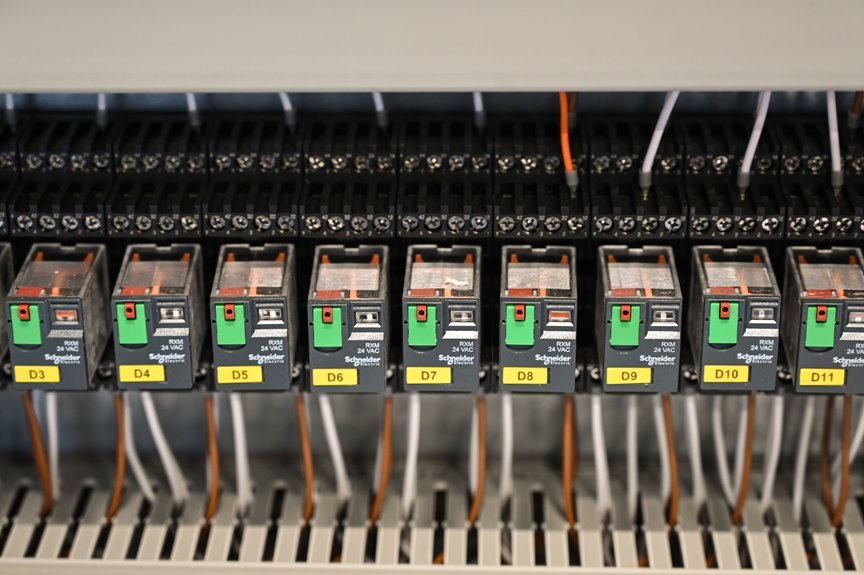
The QuantumAxis Relay Framework presents a modular approach to orchestrating quantum-enabled operations across diverse hardware and networks. It emphasizes fault-tolerant routing, standardized interfaces, and latency-aware scheduling, all under privacy, data sovereignty, and auditable governance. The framework aims to balance regulatory compliance with performance, offering clear objectives and phased deployment. Its potential impact spans finance, healthcare, and critical infrastructure, yet practical integration challenges remain. Stakeholders will find key considerations that warrant further examination.
What Is the QuantumAxis Relay Framework and Why It Matters
The QuantumAxis Relay Framework is a structured approach to orchestrating quantum-enabled communication and processing tasks across heterogeneous hardware and networks. It clarifies objectives, delineates interfaces, and standardizes measurement, scheduling, and synchronization. This framework highlights discovery paradox and latency bottlenecks, guiding disciplined evaluation.
Core Architecture: Modularity, Fault Tolerance, and Quantum-Safe Routing
A modular core architecture underpins the QuantumAxis Relay Framework by decomposing functionality into interoperable components with well-defined interfaces, enabling flexible composition and targeted optimization. This structure leverages modularity patterns to balance cohesion and coupling, supporting dynamic reconfiguration.
Fault tolerance emerges through redundant paths and state-checkpointing, ensuring resilience without centralized bottlenecks, while quantum-safe routing preserves integrity under evolving threat models and performance constraints.
Real-World Use Cases: Finance, Healthcare, and Critical Infrastructure
Finance, healthcare, and critical infrastructure present distinct, high-stakes contexts for the QuantumAxis Relay Framework, each demanding robust governance of data integrity, latency, and regulatory compliance.
The framework demonstrates cross-sector applicability through secure, auditable transactions, standardized interfaces, and resilient routing.
Privacy governance and data sovereignty considerations guide policy alignment, ensuring lawful data handling, traceability, and interoperable interoperability across diverse regulatory landscapes.
Roadmap, Challenges, and How to Get Involved With 3298591340, 3sv9xvk, 6104103666, 4028309108, 9472221080
Roadmap, challenges, and engagement strategies are outlined to guide the development and adoption of the QuantumAxis Relay Framework.
The plan emphasizes phased milestones, transparent governance, and measurable success criteria.
Dynamic governance enables adaptive policy, while vendor interoperability ensures cross-platform integration.
Risks include coordination complexity and standards drift; mitigation relies on open specifications, community oversight, and continuous compatibility audits to sustain momentum and autonomy.
Frequently Asked Questions
How Does Quantumaxis Ensure Privacy in Relay Routing?
The system provides privacy guarantees by minimizing exposure in relay routing, employing unlinkable identifiers and encrypted hop data; traffic analysis is deterred through partitioned paths, constant-forwarding proofs, and strict policy controls, ensuring robust privacy guarantees throughout relay routing.
What Are Practical Deployment Costs for Enterprises?
Deployment costs vary by scale and integration needs, while privacy strategies rely on modular controls and end-to-end safeguards; enterprises should anticipate capex and opex, plus ongoing audits, to sustain secure, scalable QuantumAxis relay deployments.
Can Non-Technical Stakeholders Understand the Framework?
The framework can be understood by non-technical stakeholders with guidance; proposal ideas should emphasize clarity and context to elevate stakeholder literacy, enabling informed evaluation. This analytical approach supports freedom-oriented decision-making and disciplined, systematic assessment.
How Is Post-Quantum Encryption Maintained Over Time?
Why wait for threats—how is post-quantum encryption maintained over time? It analyzes post quantum resilience, continuous key renewal, routing privacy safeguards, relay routing integrity, deployment costs, enterprise budget, governance models, stakeholder education, and governance-aligned maintenance protocols.
What Governance Models Support Open Collaboration?
Open collaboration thrives under governance models emphasizing transparency, shared decision rights, and modular participation. It benefits from governance benchmarking and robust collaboration metrics, enabling adaptability, accountability, and autonomous experimentation within principled, freedom-respecting open ecosystems.
Conclusion
The QuantumAxis Relay Framework stands as a carefully engineered lighthouse in a fog of competing protocols. Like a masterful navigator charting routes through shifting currents, its modular lanes, fault-tolerant bridges, and quantum-safe signposts ensure reliable passage across heterogeneous networks. Its governance and auditable steps render the harbor trustworthy for finance, healthcare, and critical infrastructure. As policy and practice evolve, the framework remains the steadfast compass, guiding interoperable, privacy-preserving voyages toward secure, scalable quantum-enabled futures.
